

360° Digital Printing: The Revolution for Personalized Gadgets
In recent years, the market for personalized gadgets has grown exponentially, becoming one of the most effective tools for companies, brands, and professionals who want to stand out and communicate in an original way. In this context, 360 digital printing represents a true technological revolution, capable of overcoming the limits of traditional techniques and offering endless creative possibilities.
But what exactly is 360 digital printing, how does it work, and what advantages does it offer compared to other customization solutions? In this article, I’ll guide you through this innovative technique, analyzing in detail its strengths, areas of application, and why it has become one of the most requested options in the promotional printing industry.
What is 360 digital printing?
The term 360 digital printing refers to a printing technology capable of reproducing graphics, logos, images, and text along the entire cylindrical or rounded surface of an object. Unlike more traditional techniques – such as screen printing or pad printing – which often allow decoration only on limited and flat areas, 360 printing enables seamless, all-around customization.
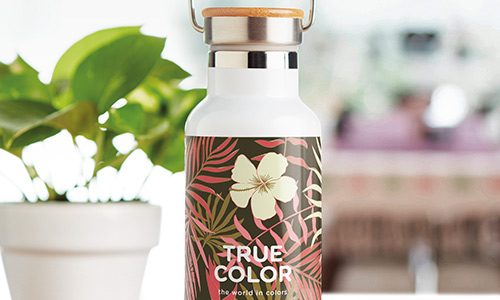
Imagine an aluminum bottle, a pen, a mug, or even a Bluetooth speaker: with this technology, it’s possible to print continuously along the entire perimeter, creating a wraparound, impactful effect.
The word “360” is no coincidence: it describes the total coverage that the printing machine can guarantee. This makes the technique ideal for cylindrical products but also for curved or irregular surfaces, greatly expanding creative possibilities.
How 360 digital printing works
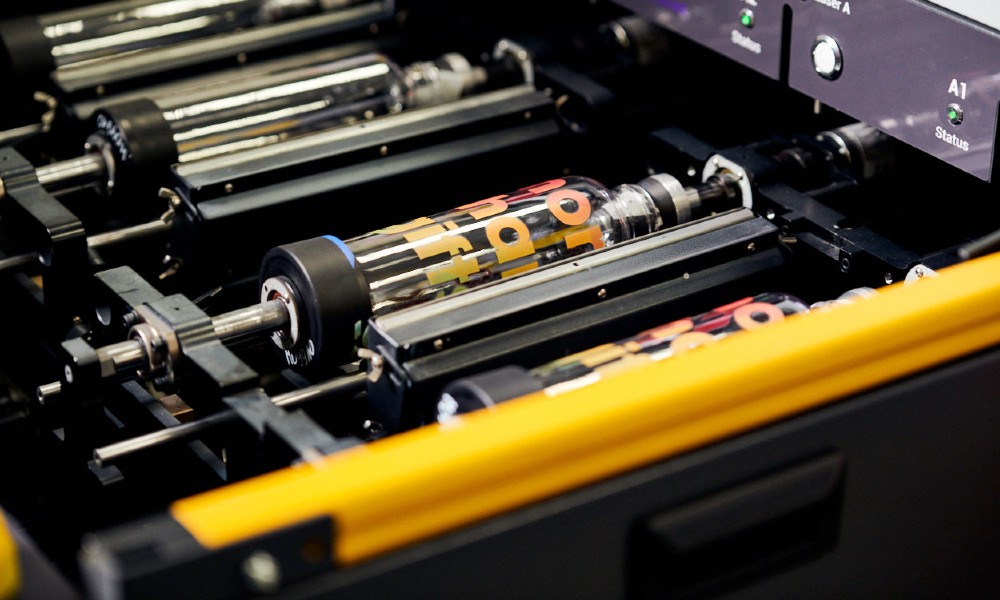
The operation of 360 digital printing is based on a direct printing process: the object is placed inside a specific machine that rotates it in a precise and controlled way. During rotation, inkjet printheads (similar to those of traditional digital printers but much more advanced) deposit the color over the entire surface.
Here are the main steps of the process:
-
Graphic file preparation
The logo, image, or graphic to be printed is processed on a computer to be adapted to the cylindrical shape of the gadget. -
Loading the object
The item to be customized (pen, bottle, glass, etc.) is fixed inside the machine, which holds it in place during printing. -
Rotation and printing
The object begins to rotate while the printheads release UV ink. This ink is immediately cured by integrated UV lamps, ensuring a quick and durable fix. -
Finishing
In some cases, special effects such as glossy or matte coatings can be applied to make the print even more eye-catching.
This system allows for high-resolution photographic prints with vibrant colors, sharp details, and without the limitations of traditional techniques.
The advantages of 360 digital printing
360 digital printing offers numerous aesthetic and functional benefits. Let’s take a closer look:
1. Total customization
The main strength lies in the ability to print over the entire surface of the gadget without interruption. This means having a much larger creative space, ideal for complex graphics or striking designs.
2. High print quality
The resolution of 360 digital printing is comparable to photographic quality. Details are sharp, colors vivid, and gradients well defined. Perfect for multicolor logos, images, or intricate designs.
3. Flexibility
Unlike other techniques, digital printing doesn’t require specific molds or screens. This means even small print runs are cost-effective, making the technology suitable for both large-scale production and small customized orders.
4. Speed
The entire process is fast: there are no setup delays, and the print is instantly cured thanks to UV inks.
5. Versatility of materials
360 digital printing can be applied to many materials: plastic, metal, glass, wood, ceramic. This opens the door to an extremely wide range of customizable gadgets.
6. Durability
UV inks are highly resistant to scratches, washing, and sunlight, ensuring long-lasting product quality.
Where 360 digital printing is used
The field of application for 360 digital printing is practically limitless. It’s the ideal choice for those who want to create unique promotional gadgets, as well as for those who want limited runs of personalized items.
Here are some examples:
-
Bottles and flasks in steel or aluminum, now among the most requested gadgets for their practicality and eco-friendliness.
-
Mugs and glasses, perfect for bars, events, or corporate gifts.
-
USB drives and electronic devices with full logo printing.
-
Speakers and power banks, increasingly popular as tech gadgets.
-
Customized pens: with 360 digital printing you get a continuous design over the entire surface.
-
Glass or ceramic objects, to create elegant and durable gifts.
360 digital printing vs other printing techniques
To better understand the value of this technology, it’s helpful to compare it with other customization methods.
-
Screen printing: excellent for flat surfaces and large quantities, but limited in colors and complex graphics.
-
Pad printing: versatile and suitable for small surfaces and details, but it doesn’t cover the entire object.
-
Heat transfer (sublimation): excellent on fabrics or treated surfaces but less suitable for untreated metal and plastic.
-
360 digital printing: combines the advantages of high quality, speed, and full coverage, without requiring molds.
Why choose 360 digital printing for corporate gadgets
Today, companies seek gadgets that are not only useful but also express identity, values, and creativity. 360 digital printing allows you to achieve all this in a single product.
-
Greater brand visibility: a logo printed all around stands out more than a small traditional print.
-
Visual impact: colorful, wraparound graphics immediately grab attention.
-
Tailored customization: it’s possible to create exclusive designs even for small runs, ideal for events, trade fairs, or personalized gifts.
-
Long-lasting results: the durability of UV inks ensures that the promotional message won’t fade with daily use.
Future trends in 360 digital printing
The technology behind 360 digital printing is constantly evolving. Machines are becoming faster and more precise, inks more eco-friendly, and creative possibilities broader. In the future, we will likely see:
-
Greater sustainability: the use of eco-friendly inks and low-impact production processes.
-
Advanced special effects: 3D textures, metallic colors, embossed prints.
-
Integration with digital design: through augmented reality or integrated QR codes, gadgets could become interactive tools.
360 digital printing is much more than just a customization technique: it’s a tool that blends aesthetics, technology, and communication. It transforms ordinary objects into high-impact gadgets capable of representing a brand in an innovative and lasting way.
Whether you’re a company looking for promotional gadgets, a designer wanting to experiment with new solutions, or simply an enthusiast of personalization, 360 digital printing is one of the best opportunities available on the market today.
Investing in this technology means choosing quality, originality, and a future driven by creativity.
Advantages
- Photographic quality
- Large print sizes
- Edge-to-edge printing
Materials
- Plastic
- Metal
- Wood
- Paper
- Polyurethane (PU)
- Glass
Items
If the printing area is flat and has a uniform surface.
- Pens
- Sliding toys
- Notebooks
- Lids
- Tech items
- Many others
Good to know
- CMYK and white-based inks
- 360 digital printing on cylindrical items
Posted in:
Personalization techniques
Related posts
-
Pad Printing: A Precision Printing Technique for Every Product
Pad printing is one of the most versatile and widespread printing techniques in the world of product customization....Read more
-
Screen printing: complete guide to the most versatile technique for customizing products
Screen printing is one of the oldest and most versatile printing techniques in the world, still widely used today for...Read more
-
Digital Printing: The Complete Guide to Personalizing Gadgets and Products
Digital printing is a modern technique that allows images, logos, and text to be reproduced directly onto a product...Read more
-
Screen Printing: The Ideal Solution for Personalizing Your Items
Screen print transfer is a printing technique that allows logos and graphics to be transferred onto fabrics and other...Read more
-
Laser engraving: the technology that transforms gadgets into unique experiences
In the world of customization, laser engraving has become synonymous with precision, elegance, and durability. More...Read more